Monday, 24 August 2020

DC2N5-LC : a 'low-cost' powerful Commodore Datassette emulator ...and much more!

Code name : 'DC2N5-LC':

It's the last version (the fifth) of a standalone device designed by Luigi Di Fraia whose purpose is to make digital backups of Commodore tapes. It can also be used as a replacement for the Commodore Datassette 'CN2' allowing you to playback tape image files.The suffix 'LC' stands for 'low-cost' but don't get fool by it because it has nothing to envy to the other commercial devices.It features a connector for the datassette port , a slot for a microSD card, where tape image files can be stored, and a cardedge connector, where a Datassette can be connected, to allow tape content imaging.

As said, it can playback .TAP files (V0, V1 and V2 supported) but what makes this device so special is the .IDX file support that allows you to playback multiload/multiside games & programs (a counter and counter reset buttom have been implemented as well).For a complete overview of its features you can visit the site of the developer :

DC2N version 5 Low Cost

This is really a must for every Commodore nostalgic so, please, support the amazing work made by Luigi Di Fraia and grab a unit! (as I happily did...)

Saturday, 22 August 2020

Time Soldiers repair log and 'ALPHA-INPUT84/87' reproduction

Bought on eBay from the States a Time Soldiers PCB which arrived to me some days ago (by the way, thanks to 'coolmod' for his mediation and forwarding) :

Auction described the board as TESTED NOT WORKING-GARBAGE ON SCREEN-MISSING CHIP

The missing chip was actually one of four program ROMs:

I programmed a blank EPROM and finally powered the board up.All I got was a partially dimmed screen in which I could recognize the power-on TEST which probaby failed since the board kept resetting:


As usually I do, I started my troubleshooting with a visual inspection.Board was in very good shape but flipping it I noticed scratches on solder side, some quite deep :

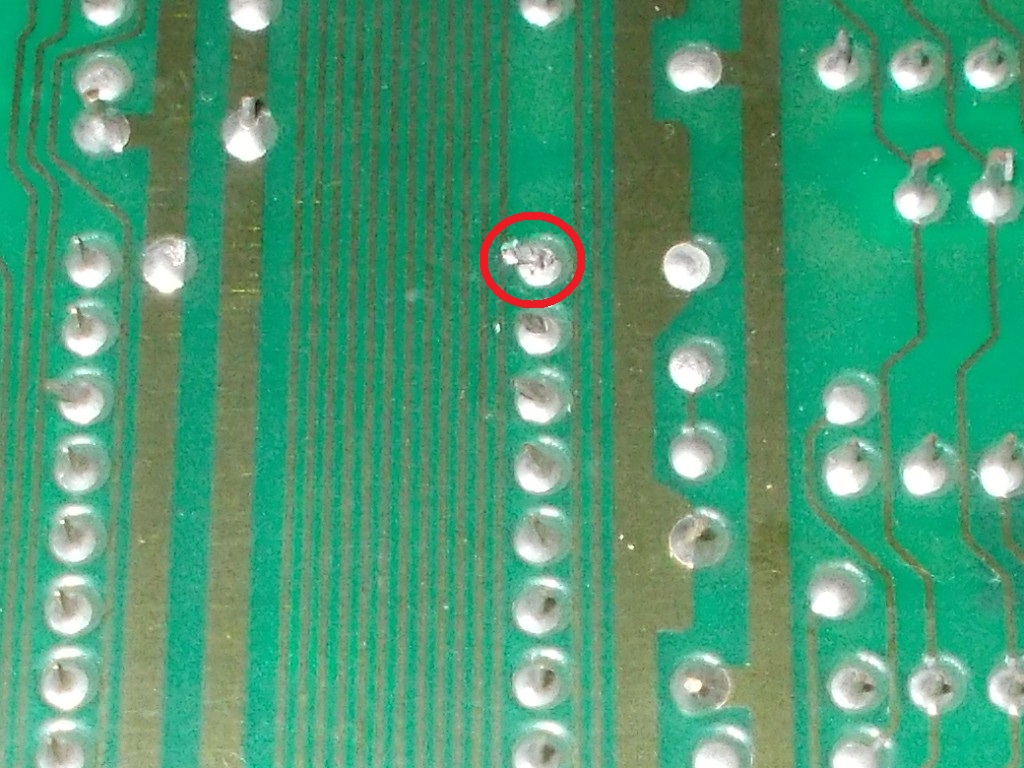
A couple of traces looked really severed under the microscope and my multimeter in continuity test confirmed it :


Patching the broken traces fixed board completely :


The repair was pretty easy, just a quick fix hence it gave me time to look for something on the board to reproduce.The long custom SIL marked 'ALPHA-INPUT84' was a good candidate :

  
This custom IC handles inputs and Time Soldiers, being a rotary joystick game, uses four of them (two for 8-way joysticks of both players and the other two the 12-way rotary joysticks).Later Alpha-Denshi games like Gold Medalist use a part marked 'ALPHA-INPUT87' that externally is identical but with slight internal differences :
 
 
The two parts are not interchangeable but I was able to merge both designs in a single reproduction part: :

 
Testing on PCB was successful on Time Soldiers PCB, all directions of both players worked with 8-way joystick (could not test rotary because I don't have them)


Another PCB and custom IC preserved!
 

Sunday, 9 August 2020

Fire Shark repair log

Got for repair a Fire Shark PCB, a vertically scrolling shooter arcade video game developed and originally published by Toaplan in 1990 (known in Japan as Same! Same! Same)

I powered up the board for the first time and it booted into game.I could coin up and play, sound was present too but screen was filled by garbage (mostly letters and numbers)


I noticed that, when I put my fingers on some pins of the 'BCU-2' custom ASIC, the screen was cleaned up from garbage although background graphics were totally absent.This custom IC is, indeed, the tilemaps generator in QFP160 package :

Looking at pinout of the 'BCU-2' found on Out Zone schematics (which runs on similar hardware) I figured out the pins I was touching where a bus that exchanges data with the near 6264 RAMs (8k x 8bit devices) 


Probing with a scope the data pins of the RAMs revealed weak signals :

This lead me to think that the 'BCU-2' was really faulty so I decided to replace it with a spare taken from a donor board.The chip came off quite easily using my hot air station :


The spare was soldered in :

Area was cleaned by flux residuals and chip was inspected with a microscope for possible bridges.All was good and ready for the test.I powered up the board again and graphics were fully restored :


I played some games with no futher issue so I could declare the board 100% working.Another sucessful repair accomplished.


Saturday, 25 July 2020

Pitfall II : The Lost Caverns repair log

Received some days ago for repair a Pitfall II PCB (on Sega System 1 hardware)
Board was in very good condition :


But on power up it gave only a solid black screen and nothing more hence deeper troubleshooting was needed.Probing the main CPU/RAM/ROM circuitry revealed that the lowest address line (A0) was stuck high on the three program ROMs and nearby RAM :


ROMs and RAM are addressed by the main CPU (a custom Z80) not directly but thru some 74LS244.I traced the stuck address line back to an output of the 74LS244 @IC124 which, according to my multimeter,  was shorted to +5V :


I was almost sure the TTL chip was bad (it was from Fujitsu too) hence I removed it but it turned out to be good.So there was something else shorting the address line to VCC preventing the game to boot.I flipped the board over and traced on solder side the shorted address line back from the ROMs/RAM.While I was following the traces I came across this :


A close-up under the microscope :


A VCC pin was bended on the nearby trace of the address line peeling-off the solder mask and causing the short, unbelievable!I promptly straightened the pin and board sprang to life :


I played some games, no further issues were present, board was 100% working.Another successful repair accomplished.


Sunday, 19 July 2020

Sega '315-5242' reproduction

The '315-5242' is a custom IC used on some Sega arcade systems :

  • System C/C2
  • System 18/24/32
  • System X
  • System Y

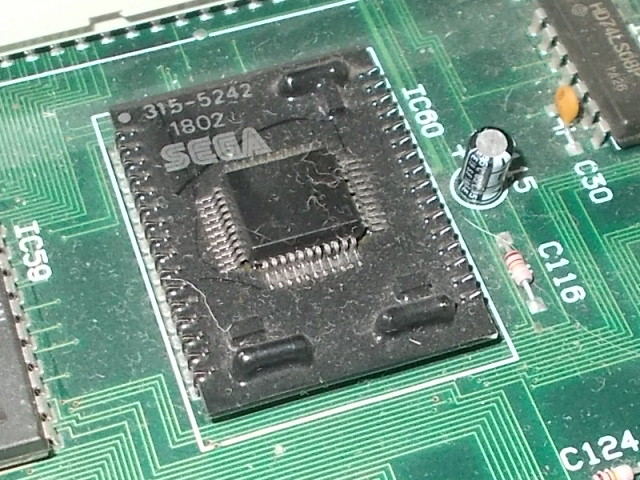
It's basically a video DAC connected to the color RAMs, which provides analog outputs for driving a monitor.It accomplishes also some special functions like making the video output grayscale instead of color or enabling shadow/highlight effect.It comes under the form of a ceramic module covered by black paint or epoxy :


The 'core' of the '315-5242' is a surface mounted IC (PQFP44 package) located on top of the module, the 'M71064' from OKI manufacturer :

No info or reference was available for this fully digital IC until some time ago when 'furrtek' decapped it and traced schematics from the silicon die revealing the internal structure and figuring out the functions :


Most of the work was done so the step to a real replacement was the easy and logical consequence.And here we are!I designed a proper board based on a +5V CPLD :


Testing on all boards I could try was successful.


Columns II (System C2)


Michael Jackson's MoonWalker (System 18)


Spider-Man (System32)


Thanks again to 'furrtek', without his brilliant work none of this would have been possible.


Saturday, 18 July 2020

Toaplan 'HK-1000' reproduction final revision

As many of you may know I made some time ago a reprodution of the 'HK-1000', a custom IC used on some PCBs manufactured by Toaplan :

Toaplan ‘HK-1000’ reproduction

The replacement was welcomed by arcade enthusiasts and collectors who used it to repair faulty boards but actually it was not a 1:1 replica of the original chip because the handling function of the coin counters/lockouts was missing since I intentionally omitted it, not considering it of primary importance. 

For the uninitiated a coin counter is mechanical style counter that increments every time a coin is inserted, here's picture of a +12VDC powered one:


Lockouts are, instead, a mechanism to prevent users from wasting an inserted coin when the cab is off or not properly operational.

Lately I've been ask more than once to implement in my 'HK-1000' reproduction the circuit needed to add these missing functions.And here we are!!This will be the final revision of the replacement, all functions of  the original chip have been implemented in it.Outwardly it has not changed from the previous ones :

  
But from now on it will be finally possible to properly use a coin meter in your arcade machine when you play those particular Toaplan boards using my reproduction :  : 

Wednesday, 1 July 2020

Data East 'VSC30' reproduction

Some time ago I had for repair an original Bogey Manor PCB by Technos (but running on Data East hardware).I was able to fix the board but I had to replace the custom IC marked 'VSC30 with a same one taken from a donor board, you can read the whole story in my repair log :

Bogey Manor repair log

After some time I sent the board back to the owner I  thought it would have been a good thing to reproduce this custom IC as well.The part come in a DIP40 .600 mil package :


Its pinout can be found in schematics of different Data east games like Express Raider, Last Mission and Gondomania :


It seems the part is involved in tilemap/background generation performing some kind of clock dividing.With this info and looking at how the same functions were achieved on previous hardware I came to a couple of designs using simple TTL gates ( I even used DIP ones because of low number needed)


I used as testing platform my original Express Raider PCB which carries one 'VSC30' on bottom VIDEO board :


The replacement worked great :


As far as I know the 'VSC30' is present on these PCBs :


  • Bogey Manor
  • Breywood
  • Express Raider
  • Gondomania
  • Last Mission
  • Shoot Out
  • The Real Ghostbusters

And perhaps some others running on similar Data East hardware of same era (see 'dec8.ccp' driver in MAME soruce) so feel free to send your findings.Also, it could be that few boards, like Bogey Manor, make use of extended features of this custom IC so, please, contact me if you are willing to test my replacement on your board.

Monday, 29 June 2020

Toaplan 'GXL-01' reproduction

My reproduction work continues with a new chapter.This time I took into account the custom IC used on some Toaplan/Taito PCBs.Silkscreening under it says 'GXL-01' :


But you can find it with different labels.On Wardner/Pyros it's 'WT1' :


'T.T.1' on Twin Cobra/Kyuukyoku Tiger :


'L-01' on Sky Shark/Hi Sho Zame :


The IC is a DIP42 .600 mil package and it accomplishes graphical functions generating the backgrounds.First of all I identified the pinout and external connections with the board.Then I thought about different designs of the equivalent circuit also studying how same functions were achieved in previous hardware.Lastly I came to a replacement board with same dimensions of original IC :


The "smoke test" was successful, the replacement worked on all boards I could try.

On Wardner/Pyros :


On Twin Cobra/Kyuukyoku Tiger :


Tuesday, 23 June 2020

Toki repair log

Received some days ago a bunch of faulty boards for repair.There was an original Toki in very good condition :


The board booted into game and was playbale with sound too but sprites were wrong :


As always I started my troubleshooting with a visual inspection and noticed that a couple of 74LS273 TTLs were replaced and sockets installed :


The work had not been done properly because some traces were broken and then patched with jumper wire on solder side :


I opted for redoing the job starting to remove the previously installed sockets :


This revealed some pads/traces were destroyed as well as some rivets ripped off from the holes.After checked all connections and rebuilt the traces I reinstalled the ICs on round machine sockets :


This lead to some improvement but the sprites had still wrong colors :


I focused on the reworked area :


Probing around I found that shorting some pins of the 'SIS6091' surface mounted custom ICs restored correct colors.I also figured out that these pins are in common between all four 'SIS6091' (probably a share bus) but I found that one pin was not.I carefully inspected the solder side of the board at the affected area and after some time I noticed a strange break in one trace.The microscope and a check with multimeter confimed that trace was really broken (it seems to me from factory more than accidentally)


I promty patched the trace, this restored corret sprites :


I played some games with no other issue found so I could successfully close this repair.


Monday, 8 June 2020

Namco '07XX' reproduction

Here's another reproduction of a custom IC I made recently.The part in question is used on Namco PCBs and comes in a DIP28 600 mil package with stamped number of  '07XX' (but the 3rd and 4th digits can vary because they actually refers to the lot/date production hence the first two digits really matters) 


Technically speaking it's a clock divider, specifically it that generates the horizontal and vertical video timing signals divided from the master clock.I made my own implementation with simple thru-hole TTL gates :


I succesfully tested my design on a Galaga PCB :


This open the way to a future implementation of this custom IC onto a CPLD or FPGA (already done by someone else though).